Overview of Infective Endocarditis
Infective Endocarditis (IE) is a very severe cardiovascular disease. This condition directly threatens the patient’s life. The main cause is the invasion of microorganisms into the endocardium. These agents are primarily bacteria or fungi.
This invasion causes serious damage to the heart valve structures. The condition often progresses very rapidly. Without timely treatment, patients are prone to heart failure or systemic embolism. Clinical statistics show that the in-hospital mortality rate remains high. This figure ranges from 15% to 20%. After one year of follow-up, the mortality rate can reach nearly 40%.
International research on the disease situation in Vietnam
To clarify the clinical picture in Vietnam, a group of experts conducted an in-depth study. This work was recently published in the international medical journal Open Medicine. This journal belongs to De Gruyter publisher and achieves Q2 standard on the Scopus system.
The study involved Dr. Vu Tri Thanh, Specialist Level II. He is currently the Director of Thu Duc General Hospital. The co-author is Dr. Nguyen Kim Anh, Master and Specialist Level II. She is the Head of the Thoracic and Vascular Surgery Department. The authors also collaborated with experts from HCMC University of Medicine and Pharmacy and the Heart Institute.
Rejuvenation trend and clinical data
The research results provided a valuable system of clinical and microbiological data. This information greatly supports diagnosis and treatment in Vietnam. A notable finding is the rejuvenation trend among IE patients today.
The change in affected demographics poses new challenges for public health. The study also reaffirms the extremely high danger level of this disease. Grasping the microbiological characteristics helps doctors prescribe more appropriate antibiotic regimens. This plays a key role in reducing patient mortality.
Recommendations from medical experts
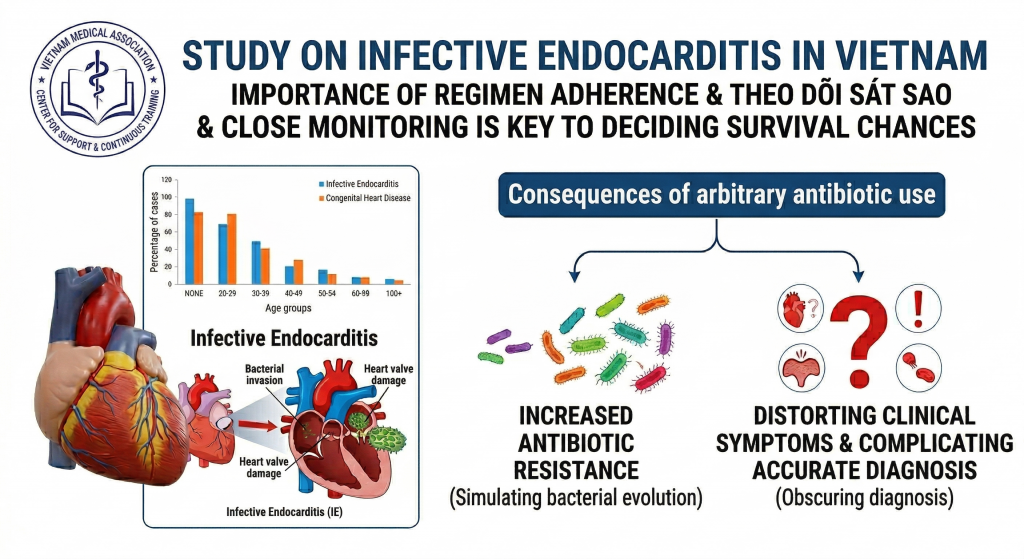
Based on the study results, experts emphasize the importance of treatment adherence. Close monitoring is the key to deciding the patient’s chances of survival. Doctors strongly advise patients never to use antibiotics arbitrarily.
Using unprescribed medication can distort clinical symptoms. This causes major difficulties for accurate diagnosis at the hospital. More importantly, this habit increases antibiotic resistance in the community. People should visit medical facilities immediately upon experiencing suspicious cardiovascular signs.
The importance of treatment adherence
Center for Support & Continuous Education