Overview and Indications
Orthodontic treatment of two jaws using traditional metal brackets is a technique for treating malocclusion disorders in both jaws using a system of metal brackets. This technique is widely indicated for patients with malocclusion in both dental arches, requiring realignment.
However, this method is contraindicated for patients with a history of allergy to bracket materials or metal archwires. Additionally, cases with acute infections in the oral cavity are not permitted to undergo the procedure until the infection is resolved.
Preparation
This procedure requires an Odonto-Stomatology specialist trained in orthodontics, supported by an assistant. Regarding technical equipment, the medical facility must be equipped with a full set of dental examination tools, specialized orthodontic pliers, rulers, cheek retractors, and a system of metal brackets and various archwires (NiTi, SS, TMA), along with auxiliary appliances such as springs and elastics.
Before proceeding, the patient needs a comprehensive examination, X-rays (panoramic, cephalometric), and medical records prepared according to regulations. The doctor is responsible for clearly explaining the treatment plan so that the patient or guardian understands and consents.
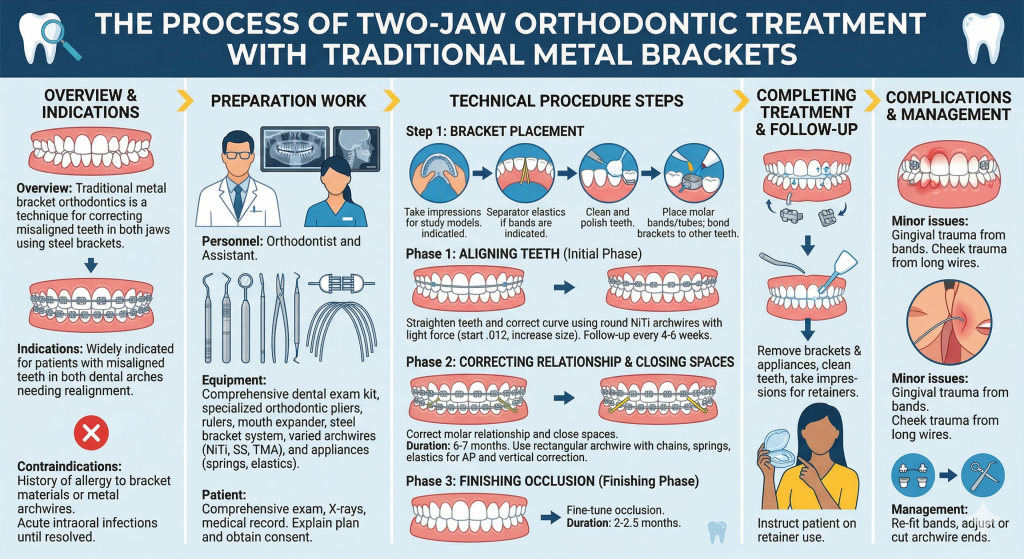
The process of two-jaw orthodontic treatment with traditional metal brackets
Technical Procedure Steps
The treatment process begins with preparation for bracket bonding. The doctor will take impressions of both dental arches to cast hard plaster models, then place separators for molars if banding is indicated. After teeth are cleaned and polished, the doctor proceeds to place bands or tubes on molars and bond traditional metal brackets to the remaining teeth using specialized bonding material.
The tooth movement process occurs in three main phases. The first phase is leveling and aligning, typically using round NiTi or Cu-NiTi wires with light force, starting with small sizes (.012) and gradually increasing. Patients need check-ups on average every 4 to 6 weeks.
The next phase focuses on correcting molar relationships and space closure, usually lasting about 6 to 7 months. At this time, the doctor will use rectangular wires combined with power chains, closing springs, or intermaxillary elastics to adjust tooth relationships in the anteroposterior and vertical dimensions. The final phase is finishing the occlusion, typically lasting 2 to 2.5 months before ending treatment.
Completion and Follow-up
Upon achieving the desired results, the doctor will remove brackets and appliances, clean the teeth, and take impressions for retainers. The patient will be instructed on using retainers to stabilize results.
During treatment, minor complications may occur, such as gingival mucosal lesions due to band embedding or cheek mucosal injury due to long archwire ends. These cases require timely management by removing and re-cementing bands or adjusting the archwire appropriately.