On March 22, 2026, the Center for Support & Continuing Education (under the Vietnam Medical Association), in collaboration with Daisy Media Joint Stock Company and Thu Cuc TCI International General Hospital, successfully organized a scientific conference with the theme: Application of advanced techniques in gastrointestinal endoscopy.
The conference was chaired by Assoc. Prof. Dr. Vu Van Khien – Vice President and General Secretary of the Vietnam Association of Gastroenterology; Assoc. Prof. Dr. Duong Quang Huy – Head of the Department of Internal Gastroenterology at Military Hospital 103, along with the participation of leading experts including Dr. Nguyen Phuc Binh – Institute of Gastroenterology and Hepatology Research & Training; Mr. Do Viet Anh – IT Director of Thu Cuc TCI International General Hospital; Mr. Hiroki Nagata – General Director of Olympus Medical Systems Vietnam Co., Ltd.
Gastrointestinal burden in Vietnam
The burden of gastrointestinal diseases in Vietnam remains at an alarming level. GLOBOCAN 2022 data show that colorectal cancer and stomach cancer rank 4th and 5th, respectively, in terms of new cases in both sexes. Many pre-cancerous lesions or early-stage cancers often progress silently. The disease has almost no clear symptoms at this stage. Most colon polyps do not show specific symptoms. Meanwhile, the NCI records that early-stage stomach cancer only causes vague signs. In this context, early detection is increasingly seen as the “golden key”. It directly determines the effectiveness of disease treatment. The WHO also emphasizes the importance of diagnosis at an early stage. This helps patients have the opportunity to access better treatment regimens, while improving prognosis and reducing the medical burden.
Breakthrough in gastrointestinal endoscopy – The Endocyto 520x
According to the representative of Thu Cuc TCI, Endocyto 520x is a new generation endoscopy technology developed by Olympus, allowing image magnification up to 520 times – helping doctors directly observe cell structures and mucosal microvessels right during the endoscopy process. Unlike previous conventional endoscopy, cell-level endoscopy expands the observation capability to the microscopic level – where the smallest changes in the mucosa can be recognized from a very early stage. This is particularly significant in the context of many pre-cancerous gastrointestinal lesions progressing silently and being difficult to detect by conventional methods.
Endocyto 520x is not considered a standalone technology, but a link in a modern endoscopy ecosystem being invested in depth. According to the implementation orientation, this cell-level endoscopy technology is integrated with imaging platforms such as TXI, NBI, RDI, EDOF, and real-time artificial intelligence (AI), creating a multi-layered endoscopy system. In this system, each technology performs a specific role: clarifying mucosal structures, identifying microvessels, improving image quality, and suggesting suspicious areas, thereby supporting doctors in assessing lesions more accurately during the endoscopy process.
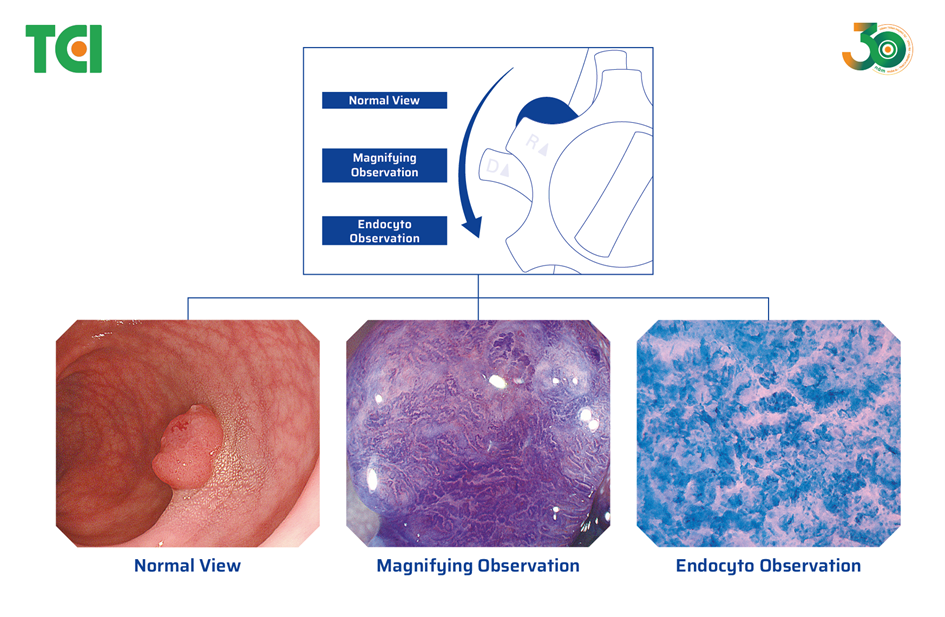
Endocyto 520x expands observation capabilities from conventional endoscopy to magnified and cell-level endoscopy
Clinical significance – Increasing opportunities for early detection of gastrointestinal cancer
Gastrointestinal endoscopy is the fundamental diagnostic method today. However, traditional techniques still carry the risk of missing lesions. Especially small abnormalities or those located in hidden, hard-to-observe positions. Meanwhile, early detection is decisive for treatment effectiveness. It can even raise the healthy survival rate to 90%. With Endocyto 520x, doctors do not just “see” the surface of the lesion. They also have additional data to evaluate in detail at the cellular level. Thereby, enhancing the ability to detect early pre-cancerous lesions. The device also supports more accurate biopsy orientation and reduces the risk of missing small, flat lesions. Notably, this system can be combined with artificial intelligence (AI). AI is likened to a “second eye” supporting the identification of very small lesions (under 5 mm). This combination contributes to standardizing the endoscopy process and improving reliability in clinical diagnosis.
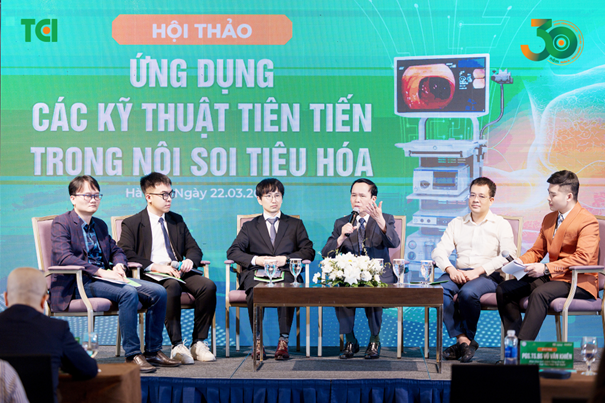
Delegates discussing modern technology trends in gastrointestinal endoscopy
Summary
The appearance of Endocyto 520x super-magnification endoscopy is a major step forward in technology. It has opened a completely new approach to the early diagnosis of gastrointestinal diseases in Vietnam. Technology has moved from conventional endoscopy to magnification and now to the cellular level. Each step forward aims at a very important common goal. That is: earlier detection – more accurate diagnosis – increased treatment opportunities for patients.
Center for Support & Continuing Education